

Being silenced
In my early days as Mayor, billboards were put up across the city by the University of Sydney featuring its alumni with taglines:
- Heart surgeon Victor Chang – I will give people a second chance at life.
- Former Prime Minister Gough Whitlam – I will champion equal opportunities for all Australians.
- Feminist, publisher and Government advisor Anne Summers – I will battle inequality with rage and reason.
There were many others, and me – community activist, Independent politician – I will shape a city that will dance on the world stage.
Amid a patriarchal culture with a conservative bias – that was quite an ambition. An ambition that required wholesale change, not just reform.
And, as many here know, people are so often hostile to change, and to changemakers. This afternoon I’ll talk about some of the roadblocks, even literal roadblocks, I’ve overcome.
I will start by acknowledging that we are living in an era where some voices are heard and some voices are not.
Increasingly, loud and influential interest groups are stifling free speech and healthy debate; some protests are outlawed; and some artists are blacklisted in the name of social cohesion.
This is not how we want to live.
People have tried to silence me too.
I have been intimidated, excluded and discredited. Predatory governments on both sides of politics even changed laws to silence me, and to this day, the right-wing Murdoch media relentlessly misrepresents what I say and do.
But I haven’t been governed by them.
Some years ago as I was on my way to Parliament, I got a call from a newspaper journalist. Have you heard what Alan Jones is saying about you? For those who don’t know, Alan Jones was a vitriolic conservative shock jock.
Anyway, I said no.
And he said: would you like to listen and make a comment?
And again, I said no.
But I did hear what he said because it made it to the news and to Australia’s broadcasting regulator. Jones said they should shove me in the same chaff bag as Julia Gillard – our first and only female Prime Minister – and that we should both be thrown out to sea.
Community backing
I lead a progressive organisation that is fair, transparent and accountable – an organisation that consults widely and gets things done. And this builds trust.
Without trust you don’t win 15 elections in a row.
Some people tell me: ‘I don’t agree with everything you do, but I’m still going to vote for you.’
That’s what I mean by trust.
The issues I campaigned on in the 1980s are the same issues I work on today – equality and inclusion for people of all ages, genders, abilities, cultures and backgrounds; action on climate change and a clean environment; well-designed public spaces and community places; affordable housing and a better deal for social housing tenants; public art and culture because it brings communities together.
I came into politics as a young mother with 2 small children, majors
in Archaeology, English and History, with stints of teaching in Sydney and London, and a passion to improve my inner city neighbourhood.
The improvements I was after were pretty modest.
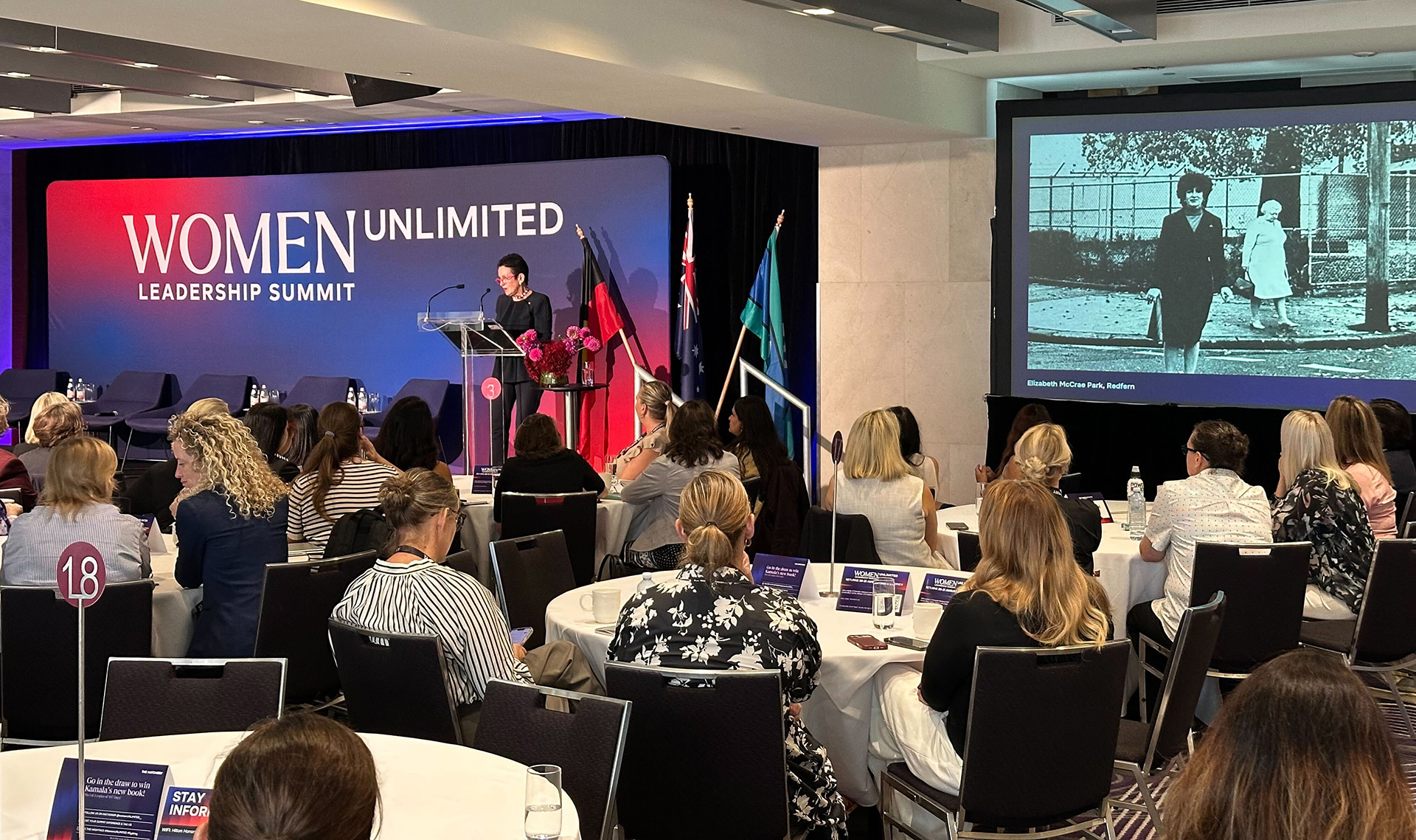
I wanted grass and safe play equipment in our local park. But I was told by a Council official the park had to be asphalt because that way it was easier to sweep up broken glass, and that no children played in the park.
I wanted to slow down the trucks dangerously speeding down neighbourhood streets. But I was told I needed 500 signatures on a petition just to start the conversation.
So I walked the streets and I got those signatures, and in the process I found others felt the same way that I did. I formed a community group, which met in our living room. I started a neighbourhood newsletter. And when elections came around and I couldn’t find anyone to run and get change in our neighbourhood, I found the courage to stand as a Community Independent for what was then South Sydney Council.
I still didn’t have much power. And I didn’t have the backing of a political party.
But when the party politicians – known as Aldermen at the time – were doing the numbers behind closed doors, I was on the street getting trees planted and playgrounds improved.
I did get grass in that park. And a whole lot more. That’s what people wanted.
But as far as the State Government was concerned, it didn’t matter what people wanted. Local councils were treated with contempt, to be manipulated by governments.
In an attempt to get a hold of the wealth and power of the City of Sydney, successive Governments have amalgamated the City council, sacked elected representatives, reinstated councils, and even amalgamated them again!
I was outraged at this manipulation of democracy, and very concerned about the future of Sydney. So I ran as an Independent for the State seat of Bligh.
Making of a progressive State
And in 1995, I held the Balance of Power with 2 other progressive Independents, and we negotiated groundbreaking reforms with the Government.
They included the introduction of 4-year fixed Parliamentary terms – before that we had short-termism in policy making and governments in constant campaign mode; greater independence of the judiciary;
a Royal Commission into police corruption; whistleblower legislation, increased independence of the Ombudsman and Auditor General, and the establishment of a Legal Services Commissioner.
These reforms were described as the most progressive in any Westminster system in the 20th century.
But it wasn’t just about governance. I was the first Lower House State MP to march in the Gay and Lesbian Mardi Gras, and have participated most years since. I have amazing memories of the parade, including a group of marching Clover lookalikes in business suits and big-hair wigs a year after my Anti-Discrimination (Homosexual Vilification) Bill became law making it illegal to incite hatred of gay men and lesbians; and after I lobbied to get more beds in Ward 17 South at St Vincents Hospital for my many constituents who had AIDS.
Fighting for the rights of gay men and women back then was considered radical activism. Homophobia was rife, and homophobic slurs and attacks were common. And, sadly, in a sign of the times, we’re seeing these crimes return to our streets.
I introduced the Adoption Amendment (Same Sex Couples) Bill which was passed in a nail-biting conscience vote, so children of same-sex couples could be adopted by both their parents.
At the 1999 Drug Summit, I moved the motion which led to the establishment of the Medically Supervised Injecting Centre in Kings Cross. And I was the only MP willing to have the Injecting Centre in my electorate. Among a concerted public scare campaign against the centre, I painstakingly explained to the community how it would save lives, get users into treatment and take injecting off the streets. And to this day it has supervised 1.28 million injections, and more than 11,000 overdoses have been managed without a single death.
I was both a State MP and Lord Mayor for 8 years until the Government changed the law making it unlawful to hold both roles. It was known as the ‘Get Clover Bill’.
I chose the City and have become the longest serving Lord Mayor and the first popularly elected woman in the City’s 184-year history. And this is despite the Government changing another law giving businesses two votes while residents had one – because they thought the business community wouldn’t vote for the Progressive Independent team that I led. This was rescinded with a change of government.
City reforms
While the City of Sydney fulfils its important municipal roles for residents and businesses, we have pursued broader social, economic and environmental reforms.
Reforms we might take for granted now, have all been hard won.
Reducing emissions
20 years ago and long before most governments, we became the first government to become carbon neutral. And 5 years ago we switched to 100% electricity from renewable sources for all our operations. We have not been silenced by the fossil-fuel industry.
We reached our goal of a 70% reduction in emissions in our operations in 2021 – nine years ahead of our target – and we are now tracking at 78%.
And we have committed to an ambitious net zero target for the whole of our local government area by 2035. By contrast the NSW Government’s target is 50% by 2030 and the Federal Government’s target is net zero by 2050.
To date we have cut emissions across our local area by 45% at the same time as our population has increased by 44%, job numbers have grown by 40%, and our economy has expanded by 79%.
Most of the world’s emissions are generated in cities, so our actions in Sydney – and the actions of all cities – are critical. Climate change is terrifying and it is underway, but solutions are not beyond us.
We changed our planning rules to ban gas in new residential developments; and in an Australian first, developers must now meet net zero energy standards for all new office, hotel and retail developments.
We are trialling insect farming by feeding food scraps to black soldier fly larvae which are processed into protein-rich animal feed and fertiliser – this is saving tonnes of methane. The Daily Telegraph described it as Clover’s Angry Army of Maggots.
We are planting more than 700 trees a year and Sydney is the only capital city council in Australia that has consistently increased canopy cover over the past decade; and we are integrating First Nations perspectives into the City’s environmental management because First Nations people have 65,000 years’ experience in Caring for Country that we are learning from.
Walking and cycling
Transport is another major emitter of carbon. But people in Sydney love their cars! I have learnt over the years, that car parking is one of the most important things in many people’s lives!
But slowly and persistently we have changed that. By recasting Sydney streets to prioritise walking and cycling, we have changed patterns of mobility and transformed local neighbourhoods.
We have widened footpaths, closed roads and encouraged outdoor dining by waiving fees for businesses spilling onto the street.
And to encourage cycling we have been systematically constructing separated cycleways. This has been revolutionary for Sydney. When I became Lord Mayor, there were no separated cycleways.
Since then, we have constructed 29 kilometres of safe, separated cycleways, 66 kilometres of shared paths and 61 kilometres of other cycling infrastructure. And bike trips have almost tripled. On each weekday, more than 10,000 people ride to work in the CBD. That’s the equivalent of 10 full trains or 166 full buses.
While fierce opposition to bike lanes hasn’t stopped, we continue to build them.
A few years back we spent $4 million building a key cycleway to safely link riders on our busiest route between the city and the eastern suburbs. This is the College Street cycleway, and it’s heavily used by commuters as well as recreational riders. But that didn’t stop the NSW Government demolishing it in a vindictive act – the Transport Minister at the time just hated cycleways. A few years later, and a change of Minister resulted in this cycleway being rebuilt, this time by the State, at a further cost of $5 million.
Continuing the bike network is critical – not only to reduce emissions.
A giant of urbanism, who I’ve been inspired by, the former Mayor of Bogota, Enrique Penalosa said a separated bicycle way is a symbol of democracy. ‘It shows that a citizen on a $30 bicycle is equally as important as one in a $30,000 car.’
Penalosa’s work underscored the principle that footpaths and cycleways are basic human rights, that streets are for people and that bike paths reinforce equity.
Transforming George Street
This venue is on Sydney’s beautiful George Street. It’s hard to imagine that only 5 years ago George Street was a noisy, traffic-choked street that was banked up with buses emitting diesel fumes.
The transformation into a tree-lined pedestrian boulevard with light rail has been spectacular. Now tree canopies provide shade and comfort; new street furniture and lighting invite people to linger; lane way upgrades and small bars are enlivening precincts, and all this has attracted $8 billion in private investment.
Town Hall Square
Our vision continues, with work now underway to acquire the final building for one of our most ambitious and long-term projects – a $300 million world-class Town Hall Square in front of Sydney’s historic Town Hall on the corner of this block.
Here we will create a place where people can gather for celebrations, cultural events, markets, and democratic protests.
In the words of Danish urbanist Jan Gehl, who advised us on the successful George Street pedestrianisation: ‘Cultures and climates differ all over the world, but people are the same. They will gather in public if you give them a good place to do it.’
Housing for social justice
City making is also about our social systems – how we treat people.
Housing affordability continues to be a big issue affecting Sydney, as well as other cities across Australia and the world.
While housing is a State responsibility under our 3-tiered government system, the City uses all available levers to provide as much affordable housing as we can. We do that by providing grants and selling our land at a discount to Community Housing Providers; by applying levies and negotiating planning agreements with developers; and by changing our planning controls.
These measures have resulted in 3,466 affordable and diverse homes – either built, in the pipeline, or expected – more than any council in Australia.
We are also investing more than $2.2 million a year to reduce homelessness, and every day our officers walk the streets linking people sleeping rough with the services they need.
We are continuing our fight against the hollowing out of social housing across the City.
First Nations
The City is home to one of metropolitan Sydney’s largest Aboriginal and Torres Strait Islander communities, and from the time I became Lord Mayor, we have worked on establishing and maintaining respectful relationships with communities.
One of my first actions was to change the description of European arrival in our corporate documents from ‘colonisation’ to ‘invasion’. Truth-telling about Australia’s history sits at the heart of meaningful relationships with Aboriginal and Torres Strait Islander communities.
We also updated our busking policy so Aboriginal and Torres Strait Islander peoples can practice their culture in the City without needing a busking permit. Practicing and expressing culture by performance, storytelling and art is an important part of cultural identity and ceremony – a practice that is recognised by the United Nations Declaration on the Rights of Indigenous People.
In the past, the heritage and cultures of Aboriginal and Torres Strait Islander communities were neither visible nor celebrated in our City. This has changed. Now anyone in Sydney knows they are on Gadigal land. Aboriginal and Torres Strait Islander people are involved in major public events and artworks including:
- Our New Year’s Eve fireworks, which are broadcast live to about
1 billion people around the world and a million people along our Harbour. They opened with an Aboriginal smoking ceremony followed by spectacular Calling Country fireworks and projections on the Harbour Bridge pylons in a beautiful display of Aboriginal stories with a message of strength, love, resilience and unity. - The City’s Eora Journey walking route – from the site of first contact on Sydney Harbour to the home of Aboriginal activism in Redfern – is marked out with major public artworks. The route is being curated by esteemed Arrernte [are-run-tay] and Kalkadoon [kal-kah-doon] curator, writer and activist Hetti Perkins. The latest artwork is bara by Wani [whan-yi] artist Judy Watson in the Botanic Gardens – a 6.4-metre marble representation of a fishhook that Aboriginal women made for fishing in and around the Harbour.
- And a few weeks ago, on Invasion Day otherwise known as Australia Day, about 65,000 people gathered across the day and night in Victoria Park for the Yabun Festival – Sydney’s most significant celebration of Aboriginal culture, language and community. It was a great day showcasing First Nations culture and music, talent, food, businesses and more.
Diversity, equity, inclusion
Our progressive policies are creating a global city that is diverse, inclusive, equitable and liveable.
Liveability and sustainability are essential to attracting and retaining people and ensuring the efficient and productive operation of our city. People want to live and work where there is good and easy access to jobs, schools, community and cultural facilities, parks and leisure. Liveability is intrinsically linked to economic growth.
The City’s progressive policies have led to thriving communities, a rich array of cultures, skills, experiences and languages. This means our city attracts smart, talented, and creative people.
The decisions we make today about investments in infrastructure and social policies show who we are and the City we will become. They are good for people and good for business.
Socially progressive politics is hard work that takes leadership, conviction and courage.
But building a strong, diverse, equitable and inclusive society is a shared responsibility for all governments, businesses, not-for-profits and the wider community, including each of us.
We are part of the same global community. And we all have a responsibility to use our voices, our education and our many other advantages to ensure all voices are heard.
Sydney continues to transform into a beautiful and sustainable global city, equipped for the challenges of the 21st Century.
But there’s a lot more to do.
One thing the political parties, vested interests and the media can count on is that I won’t be silenced, diverted or put off by bullies.
People say that ‘I am my job’ because I have gladly devoted 21 years to this city – in that time outlasting 7 prime ministers and 9 premiers – and another 25 years before that in the NSW Parliament.
I’ll continue to build trust, listen to communities, and to be guided by my principles.
A former Mayor said he wished he had fixed the play equipment and put down some grass in my local park – his life, and that of his Party, would have been a whole lot easier.

