

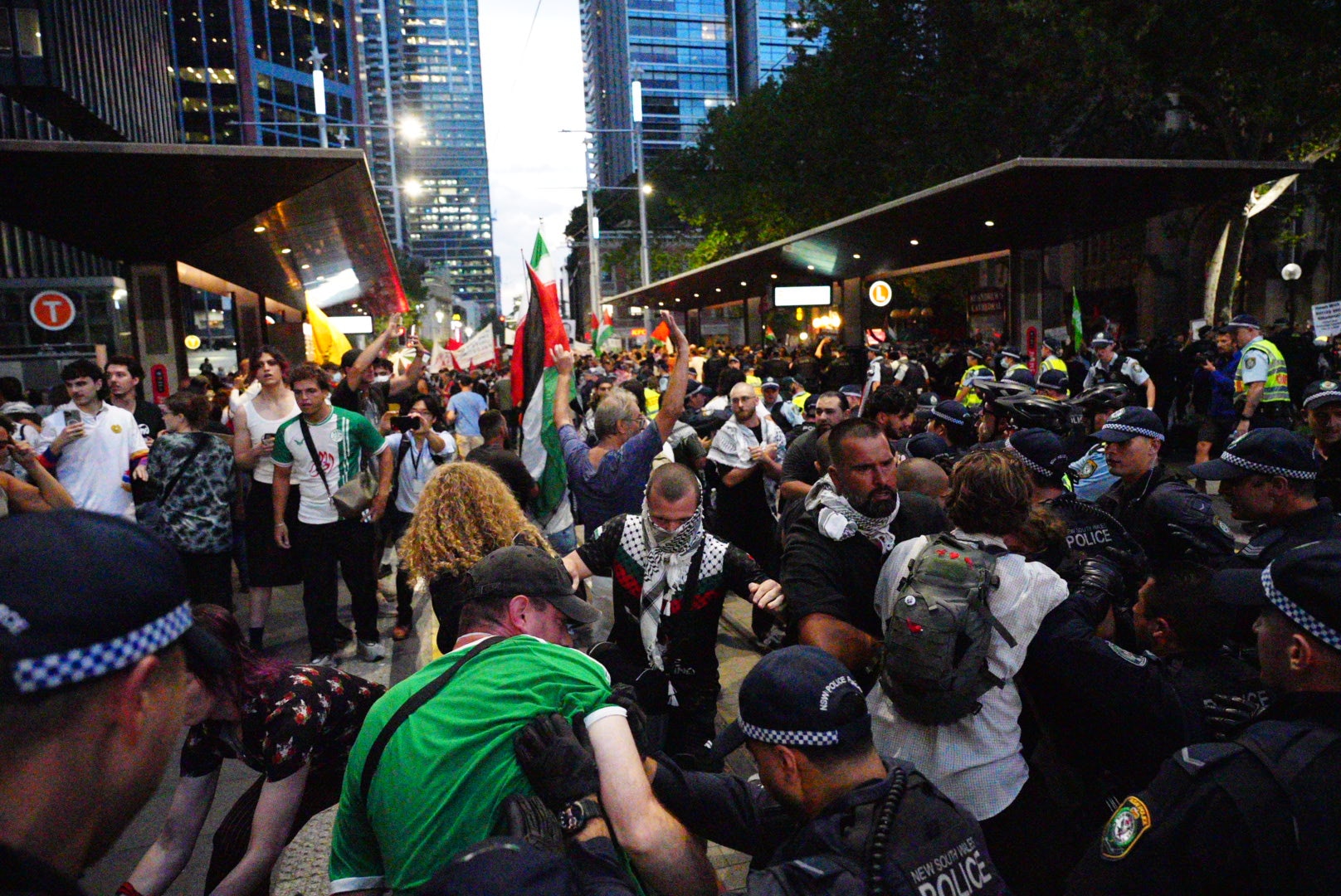
The violent clashes between police and protesters on 9 February 2026 were incredibly shocking and distressing. The scenes that unfolded across our city did not look like Sydney at all.
Sydney is one of Australia’s most diverse cities, home to people of many cultures, faiths, identities and political views.
Our city is a beacon of acceptance for people from different parts of Australia and the world. People from different walks of life come here to live and work, because we are open to diverse opinions, world views and political and religious beliefs, even if sometimes we disagree.
9 February 2026
The protest on 9 February was legitimate. It is legitimate to use our voices to call for an end to the genocide in Gaza, especially during a visit by the Israeli head of state.
The suggestion that such protest is inappropriate as we continue to grieve for the victims of the egregious, Antisemitic terror event in Bondi is a divisive, false dichotomy. We use our voices to call on all parties to adhere to the conditions of negotiated ceasefire and usher in a just and lasting peace, and that call does not affect our deep sympathy and solidarity with Jewish communities.
Police play a critical role in maintaining community safety and ensuring the public can access shared spaces, and the complexity of this work is acknowledged. The Police Act also requires officers to uphold the rights and freedoms of the community and to exercise their authority responsibly. While protests must remain peaceful, safe and respectful, prohibiting them - or responding with disproportionate force - is not an appropriate response.
Regardless of views about particular protest groups or their causes, the use of excessive force against community members is deeply concerning. Community trust in policing depends on discretion, respect, transparency and accountability; without these, people may come to fear police rather than feel protected by them.
For the 9 February protests, I understand that the Police had very clear instructions on where people should be, and the violent clashes may have broken out when people challenged those demarcations. But seeing the unrestrained force used to impose those demarcations was disturbing.
There has to be a better way for police, who were out in intimidatingly large numbers, to manage crowds safely. I found the footage of men being aggressively dragged away in the midst of evening prayer, and protestors beaten while already subdued, particularly alarming.
We cannot simply say the images aren’t a good look, or that police were just doing their jobs in trying conditions or play a blame game – the community needs to be able to trust the police, and that trust relies on transparency and accountability.
I’m pleased that the independent Law Enforcement Conduct Commission has initiated an investigation into possible serious misconduct by police on 9 February. It is essential that this investigation is properly resourced, and I propose writing to the Premier requesting that he ensures this.
I have asked the Chief Executive Officer to ensure any CCTV footage around Town Hall that evening captured through our Street Safety Camera Program is retained for longer than the normal 28 day period to assist with investigations.
Erosion of civil liberties
Both our State and Federal Governments have committed to addressing the terrible rise in Antisemitism and Islamophobia in our communities and that is most welcome. As is any effort to achieve “social cohesion”. But we should be careful not to erode civil rights or chill genuine protest in the process. That doesn’t unite us or make us feel safe.
Even before the shocking events of 9 February, the City of Sydney Council had repeatedly (November 2022, December 2022 and March 2023) resolved support for the right of peaceful assembly and protest, and called for an end to pre-emptive and heavy-handed policing of protests.
The right to protest is not only legal, but also fundamental in a free and democratic society. Many of the rights we take for granted today came from protests. The suffragette movement won the right for women to vote. Only after tireless, sustained protest did First Nations peoples win the right to vote. Unions did not secure the eight-hour workday without protests and strikes.
In recent years, we have witnessed a global assault on democratic processes and government institutions, increased geopolitical tensions, a winding back of diversity and inclusion measures in some parts of the globe, and a renewed attack on climate action. This has prompted many to express their democratic right to peaceful protest.
However, since 2022, protest rights have been progressively eroded in NSW through a series of legislative changes, including:
- The Roads and Crimes Legislation Amendment Act 2022, preventing ‘illegal protesting’ on major roads.
- The Crimes Amendment (Obstructing a Railway) Act 2024, targeting protests that obstruct railway lines.
- The Crimes Amendment (Places of Worship) Act 2025, stopping protesters from impeding, intimidating, or harassing people at churches, synagogues, and mosques.
These amendments imposed disproportionate fines of up to $22,000 and/or up to two years in gaol for a variety of offences associated with public protest activities.
While these new laws received bipartisan support, the changes were strongly, and rightly, opposed by human rights, environmental and civil liberties groups. In 2023, the NSW Council for Civil Liberties said “NSW cannot be prosecuted into social cohesion”, in response to previous erosions to free speech by the Minns Government.
Two of the amendments were challenged in court - the Roads and Crimes Legislation Amendment Bill 2022 and the Crimes Amendment (Places of Worship) Bill 2025, both of which succeeded because the rushed anti-protest laws were drafted so broadly that they unjustifiably restricted the implied freedom of political communication, preventing people from being seen and heard when protesting.
Undeterred by the courts, the NSW Government doubled down with the Terrorism and Other Legislation Amendment Act 2025 placing even broader restrictions on protest. The laws give police the discretion to ban authorised public assemblies in specific areas, a fortnight at a time, for up to three months following a terror attack. Police were also given new powers to direct people to move on who are engaged in apparently genuine demonstrations or protests being held in an area where the Police had declared the declaration applied.
The Government also activated extraordinary police powers to control crowds, restrict movement and conduct searches declaring Israeli President Isaac Herzog's visit a "major event" under laws designed to encourage large sporting and cultural events, like the Olympics.
As a result of these legislative changes, the United Nations Special Rapporteur on human rights and counter-terrorism says, “NSW is now one of the most draconian anti-protest jurisdictions in the democratic world”.
Failure of leadership
The Organisation for Economic Co-operation and Development explains that “a cohesive society works towards the well-being of all its members, fights exclusion and marginalisation, creates a sense of belonging, promotes trust, and offers its members the opportunity of upward mobility.”
As citizens we have the right if not a moral duty to stand up for those who have been marginalised, and excluded, and one way we do this is through peaceful protest.
What the NSW Government fails to understand is that by eroding our civil liberties, they are in fact undermining the so-called “social cohesion” they claim to be protecting.
The restrictions introduced in December characterise every protest critical of Israel as a risk to community safety. This is despite the fact that over the past two years there have been dozens of peaceful protests, involving hundreds of thousands of Australians, including the historic March for Humanity across Sydney Harbour Bridge in August 2025, which I was proud to take part in along with many City of Sydney Councillors, former NSW Premier Bob Carr and the Hon. Ed Husic MP, and leaders across the political spectrum, in the pouring rain.
Applying broad, blanket limits on protest unfairly labels all protesters as safety risks. These unnecessary limits on democratic freedoms are actually creating more social division and political marginalisation. Those conditions can make protests more likely to become disorderly, not less.
Everyone has a right to safety in our city – whether that be safely accessing their workplace, or living free from discrimination and expressions of hate. It is the Government's job to protect that right.
But our civil rights – our right to gather in genuine peaceful protest – are equally important. We should be careful not to accept the erosion of these rights or to allow governments to stifle genuine political activism. If we truly value inclusion and diversity, we must ensure all our communities are permitted to gather, whether to reflect and mourn, or voice opposition to violence and war – safely and freely.
The NSW Government must urgently review and repeal those laws that stifle legitimate peaceful protest.

